Tuesday, 3 April 2012

Everlasting Love Unfeigned: My Understanding of Christianity

God is love. Whoever lives in love lives in God, and God in them. (1 John 4:16)

There is a spirit which I feel that delights to do no evil, nor to revenge any wrong…. for its ground and spring is the mercies and forgiveness of God. Its crown is meekness, its life is everlasting love unfeigned. (James Nayler)

Jesus, Thou art all compassion, Pure unbounded love Thou art; Visit us with Thy salvation; Enter every trembling heart. (Charles Wesley)

  1. God is spirit and the source of all things. The essence of God is love, everlasting love unfeigned, pure unbounded love.
  2. Humans were created in the image of God. This means that they were created in communion with God, sharing God’s capacity for pure unbounded love.
  3. In what is known as the ‘Fall’ humans became deluded, imagining themselves to be independent and autonomous when in truth all things proceed from God and are interconnected and interdependent. Breaking their unity with God, humanity lost the image of God within them (the capacity for pure unbounded love).  
  4. The fallen state, in which humans find themselves out of harmony with God, each other and the rest of creation, is characterised by division, violence, hatred, injustice and greed. This is the very opposite of pure unbounded love.
  5. In his life and ministry Jesus represented pure unbounded love in human form. Through him the image of God was reintroduced into the human world.
  6. The pure unbounded love of Jesus (his obedience to God) brought him into conflict with a world dominated by division, violence, hatred, injustice and greed. His unwillingness to compromise with this evil led directly to his death on the cross.
  7. God raised Jesus from the dead as a sign of his victory over darkness. The pure unbounded love of Christ was victorious over the evil and hatred in the world (Christus victor).
  8. The way of Christ (pure unbounded love) became available to all when the Spirit was poured out on all flesh at Pentecost. This Spirit has the power to establish the image of God within people.
  9. The Spirit is available to everyone but it is not imposed on anyone. People have a choice; they can receive the Spirit and allow it to transform them and establish the image of God within them or they can ignore and reject it.
  10. Christ is returning and the Kingdom of God is coming bit-by-bit and piece-by-piece as the image of God is established in each person and the world is increasingly ruled by pure unbounded love.
  11. The Church and individual Christians are called to make this transformation visible in the world by living a life of pure unbounded love. Such a witness brings them into conflict with the darkness in the world and may result in suffering and persecution as it did for Jesus. This is what it means to ‘take up the cross’.
  12. Being the essence of pure unbounded love, God’s care for the Church and for individual Christians is no greater than God’s care for everyone and every thing else. The church has simply been called to a particular task in the divine plan for the restoration of all things
  13. Since the Spirit has been poured out on all flesh and is available to everyone, it is visible in all religious traditions and human cultures where unbounded love can be seen to flourish.

Friday, 16 March 2012

Why Do We Blame the Victim? In Defence of James Nayler

Advices and Queries no.35 - Respect the laws of the state but let your first loyalty be to God's purposes.


In the authorised version of Quaker history it is received wisdom that James Nayler, although a man of deep spirituality with a significant gift for preaching and writing, was an unstable and ‘Ranterish’ character who brought the Quaker community into disrepute. This perspective assumes that it was Nayler’s conduct in Bristol in 1656 that forced the movement to exercise greater control over its more turbulent adherents by establishing a system of corporate structures and community discipline. I want to argue that modern Quakers should question this received wisdom by adopting a sceptical and critical approach to all narratives that seek to explain events in a way that blames the victims for the suffering and persecution they endure. I will try to do this with reference to the actions of Jesus in ‘cleansing the Jewish Temple’ and modern examples of civil disobedience.

Nayler’s Ride into Bristol

On a rainy Friday afternoon on 24 October 1656 James Nayler entered the City of Bristol accompanied by a small group of bedraggled followers. They led him on a horse as they waded through the muddy streets singing ‘Hosanna’ and ‘Holy, holy, holy, Lord God of Israel’. This was clearly and intentionally a re-enactment of Jesus’ entry into Jerusalem on ‘Palm Sunday’. However, like this biblical scene, Nayler’s re-enactment did not bear the hallmarks of a ‘triumphant’ display of earthly power. Instead it seemed to represent an inversion of the world’s expectations. Nevertheless, the entire party was arrested and taken to jail. Those in power within the English Commonwealth, who had become increasingly alarmed by the rapid growth and subversive nature of the Quaker movement, saw this as a perfect opportunity to crack down on Friends by making an example of Nayler. He was taken to London to be tried by Parliament for blasphemy even though this assembly had no legal jurisdiction to do this. The charge of blasphemy rested on the accusation that Nayler was claiming to be Jesus Christ. However, as his testimony to Parliament makes clear the Bristol event was an outward sign dramatising the Quaker belief that Christ had returned in spirit and would dwell within all who accepted him. He said:

"I do abhor that any honours due God should be given to me as I am a creature, but it pleased the Lord to set me up as a sign of the coming of the righteous one. . . I was commanded by the power of the Lord to suffer it to be done to the outward man as a sign, but I abhor any honour as a creature.

Despite this unequivocal statement, the political objectives of Parliament far outweighed any consideration of justice and Nayler was convicted of ‘horrid blasphemy’. Only narrowly avoiding execution he was sentenced to a particularly brutal form of punishment. This included being pilloried and receiving 310 lashes through the streets of London which very nearly killed him. He was pilloried again and had his forehead branded with a letter B for blasphemer and his tongue bored through with a hot iron. Following a largely ritualistic flogging in Bristol, he was imprisoned for an indefinite period at Bridewell. After his sentencing Nayler responded:

God has given me a body; he shall, I hope, give me a spirit to endure it. The Lord lay not these things to your charge. pray heartily that he may not.

The Punishment of James Nayler

The case was used to maximum effect for propaganda purposes and in the aftermath Quakers suffered more intensive persecution at the hands of the authorities. Nayler was all but disowned by significant sections of the Quaker movement due to the alleged damage he had caused and for daring to challenge the leadership of George Fox (there had been significant conflict between the two men in the lead-up to the Bristol incident and Nayler’s followers were instrumental in pressing his leadership claims). Although Nayler was later released from prison and reconciled with the wider Quaker movement, his health was broken and he died in October 1660 after being robbed while travelling home to Yorkshire to visit his family.

Jesus Cleanses the Temple

Jesus’ ‘triumphal’ entry into Jerusalem represents the beginning of the end of his ministry. Shortly after this event, Jesus visited the Temple in Jerusalem which was the centre of Jewish worship and viewed figuratively as the ‘footstool’ of God’s presence. It is difficult to over-estimate the religious and political significance of this sacred place. Having witnessed what was going on in the Temple during his first visit, Jesus returned the next day and drove the money changers and all those involved in buying and selling from of the Temple courtyard accusing them of turning it into “a den of robbers”. It would appear that this action sealed Jesus’ fate. The Sadducees, who were part of the Jewish elite and collaborators with the Roman occupiers, decided that Jesus was a subversive and a threat to social order. In order to protect their power and privilege, he had to be neutralised. Not long after, Jesus was arrested by the Temple authorities who, in collusion with the Romans, had him executed by crucifixion. His followers scattered and the Jesus movement appeared to have been crushed. As we know however this was by no means the end of the story.

Jesus Cleanses the Temple

How do we respond to the actions of Jesus in the Temple courtyard? If we apply the approach traditionally used to interpret the ‘Nayler incident’ we will have to conclude that Jesus’ behaviour was irresponsible, blasphemous and downright provocative. It was bound to get him into trouble, endanger his followers and bring his movement into disrepute. He deliberately caused a disturbance within Judaism’s most sacred place and threatened social order in the circumstances of Roman military occupation. Was this not madness? Did Jesus have a death-wish?

Modern Non-violent Action

In the modern era we have seen many important examples of individuals and groups choosing to consciously break the law or contravene social conventions as a form of non-violent action.

Gandhi on the Salt March

The architect of modern non-violent resistance, Mohandas Gandhi, used a method of non-violent direct action he called Satyagraha in the struggle for Indian independence. In the Salt March of 1930 Gandhi organised a massive campaign of civil disobedience to protest about the British monopoly control of salt supplies. This involved a range of unlawful acts including tax resistance and led to beatings and imprisonments on a large scale.

Rosa Parks

In the US State of Alabama on 1 December 1955 a Black women by the name of Rosa Parks refused a bus driver’s order, based on State law and practice, to give up her seat for a white passenger. She was arrested and jailed. This act of disobedience prompted the Montgomery Bus Boycott and galvanised the modern American Civil Rights Movement. In this struggle for racial equality many activists were beaten, jailed and murdered by white racists.

Mordechai Vanunu

In 1986 the Israeli technician Mordechai Vanunu, outraged by his government’s covert development of nuclear weapons, passed information about this programme to the British press. He was then lured to Italy by a Mossad agent, where he was drugged, kidnapped and transported to Israel to be tried in secret for treason and espionage. Following his conviction he was imprisoned for 18 years. Much of this time was spent in solitary confinement. Since his release in 2004 he has suffered severe restrictions on his speech and movement.

How do we respond to the actions of these people? If we apply the approach traditionally used to interpret the ‘Nayler incident’ we will have to conclude that their behaviours were criminal, seditious, treacherous and knowingly designed to undermine law and order and social well-being. What they did was bound to get them into trouble, endanger their communities and bring their beliefs into disrepute. They deliberately broke the law and provoked conflict in sensitive and difficult circumstances. Was this not madness? Did they all have a death-wish?

Of course, how we respond to these examples depends on where we stand on the issues concerned. Quakers and many other people would regard Jesus, Mohandas Gandhi, Rosa Parks and Mordechai Vanunu as heroes, liberators, justice-seekers and role-models but to those in power they were dangerous, they were the enemy. They threatened the very values, beliefs and practices that bind societies together and they undermined the security and well-being of God’s favoured nation or empire.

Revisiting the 1650s

Throughout most of the 1650s the burgeoning Quaker movement waged a provocative but non-violent spiritual campaign (the Lamb’s War) against the established church and the Commonwealth Parliament. They disrupted church services, confronted the clergy, disputed with opponents in public, refused to show deference to their ‘superiors’, staged startling happenings such as ‘going naked as a sign’, and dispensed threatening prophetic warnings to those in power. Not surprisingly, they were regarded by those in power as a very serious threat to social order at a time of great political turmoil. This is why they made an example of James Nayler and used his actions as an excuse to persecute the Quaker community as a whole.

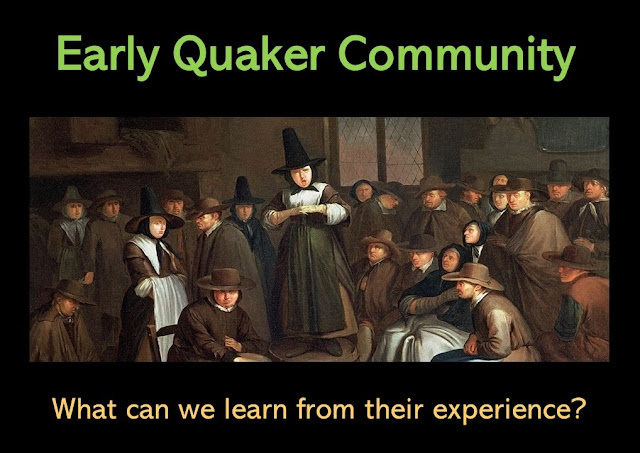
An Early Quaker Meeting

What provoked radical groups such as the Quakers was the failure of the commonwealth regime to deliver the promises made during the English Civil Wars that victory would lead to far-reaching social, political and religious reform. The expectation that a new society would be created based on greater equality, democracy and religious freedom was disappointed. For much of the period, the country was under military dictatorship, dissenting groups were persecuted and the army was busy slaughtering thousands of people in Ireland. In these circumstances to hold James Nayler responsible for his punishment and the persecution of the Quaker community is simply to blame the victim. Nayler’s behaviour at Bristol was entirely consistent with the essential character of the early Quaker movement. His actions involved no violence, no coercion and no threats to people or property. He simply enacted an outward physical sign representing what he had found to be true inwardly and spiritually.

Let's Stop Blaming the Victim

It was those in power who illegally tried James Nayler and tortured him almost to the point of death. It was those in power who flogged Quakers in the market places, locked them in the stocks and the pillory, provoked mobs to attack them and threw them into disease-ridden dungeons at the mercy of brutal jailors. The time has come to stop blaming the victim and instead defend James Nayler as a Quaker hero, justice-seeker and role model.

Thursday, 8 March 2012

Coming to our Spiritual Senses

We begin the prodigal's journey home to the eternal Spirit we call God when we recognise that our spiritual senses are debilitated. Our sight is dim and out of focus, our ears are blocked and sound is muffled, our mouths taste no sweet savour, life has no fragrance, and a cold numbness prevents us from feeling what's right under our finger tips.

Coming to our spiritual senses and accepting their need for care and attention is a crucial first step on the journey because it reveals the value of a discipline that nurtures our capacity to listen, to see, to smell, to taste, and to touch. We might then discover that what we really need has been present all along but we were unable to hear it, or see it, or smell it, or taste it, or touch it. We simply didn't know it was there.

"The same Spirit that made the globe is the indweller in the five senses of hearing, seeing, tasting, smelling and feeling" Gerrard Winstanley

Tuesday, 6 March 2012

Going to a Better Place? religious ambivalence towards the creation

“….we are renewing our commitment to a sense of the unity of creation which has always been part of Friends’ testimonies.” (Minute 36, YM 2011)

Quakers in Britain have committed ourselves corporately to the goal of becoming a low-carbon community, to being a people who live increasingly in harmony with the order of creation. Minute 36 of Yearly Meeting 2011 asserts that this commitment is consistent with our historic testimony. I want to argue that, like most religious traditions, the Quaker record in caring for the creation has been a mixed one but that, despite this, at the heart of the earliest Quaker experience can be found the seeds of a creation spirituality that has direct relevance to the urgent challenge of ecological sustainability we face today.

As a faith community, it is difficult to avoid confronting the accusation that religion is fundamentally part of the sustainability problem. Many of the world’s religions have displayed, in one form or another, a distinct ambivalence towards the physical creation. On the one hand, they have produced disciplined individuals and communities who have rejected materialism, lived simply and trod lightly on the earth. On the other hand, they have devalued the creation, either intentionally or unintentionally, by giving priority to a spiritual form of existence in which the physical world plays no part. Eastern traditions have tended to focus on the need to escape from the cycle of death and rebirth, whereas western traditions have been preoccupied with heaven as a spiritual destination, and with the apocalypse as the destruction of the physical world. Such a mindset can have quite negative implications; if we are ultimately ‘going to a better place,’ why should we care about this place?

Being rooted in Christianity, Quakerism inevitably needs to engage with the legacy of this religious tradition. Because of its long-standing status as the established religion of empire and nation state, Christianity has been used to uphold and legitimise dominant social and economic structures. During the past 300 years this has included support for the development of industrialisation and capitalism, which have had such a far-reaching impact on the natural world. In particular, the biblical account of the creation in the Book of Genesis has been used to justify human exploitation and control of the rest of the natural world. This interpretation argues that God granted humans ‘dominion’ over the creation and commanded them to ‘subdue’ the earth (see Genesis 1: 26-28). The concept of human stewardship of the creation has also developed largely as a result of such a reading of Genesis. Within medieval European societies a ‘steward’ was an official appointed to represent a ruling monarch in another country, often with a mandate to govern it in the monarch’s name. Do we really regard ourselves as God’s appointed officials on earth? From an ecological perspective, there are a number of serious problems associated with the traditional understanding of dominion and stewardship. It implies that humanity somehow exists outside and above creation, rather than being fully integrated within it. It asserts that humans have a divine right to control and exploit the creation for their own benefit. Finally, it assumes that humans have both the necessary power and knowledge required to effectively manage the incredibly complex system we call creation.

Similar issues emerge and the same sort of ambivalence towards the creation can be observed when we consider the Quaker story.

Confidence in the power of the Spirit to transform humanity has been an essential characteristic of the Quaker movement from the start. Ours is a faith that asserts the real possibility of living in the kingdom of heaven here and now. As a result, rather than seeking to free ourselves from the bonds of the physical world, Quakers have tended to stress the goodness of creation and have paid less attention to the idea of heaven as a spiritual destination awaiting us after death. The emphasis on plainness and simplicity in Quaker testimony has reflected an experience of spiritual transformation that turns our attention away from the ephemeral and towards the things that are eternal. This, in turn, has produced a wariness of extravagance, unrestricted consumption and excessive busyness. Quaker compassion for animals and opposition to animal exploitation and cruelty has been a long-standing concern. It is visible in the very earliest Quaker witness in the mid-17th century and continues today in the work of groups such as Quaker Concern for Animals. Finally, our current concern for sustainability is consistent with historic Quaker witness and maintains continuity with earlier concerns. It seems clear to me that these aspects of Quaker testimony are inextricably linked to our belief in both the fundamental goodness of creation and in the universal human potential, when empowered by the Spirit, to turn to the Light and away from darkness.

Although there is much in Quakerism that is creation-affirming, we must not let rose-tinted spectacles blind us to those aspects of our tradition that represent more ambivalent attitudes towards the creation and less environmentally-sustainable practices. Despite the strongly creation-affirming aspects of Quakerism, we must also recognise the influence of spiritualist and Gnostic thinking among some Friends. This sort of dualistic thought views the spiritual realm as eternal, incorruptible and good, and the material realm as temporal, corruptible and evil. The early Quaker use of dualistic-sounding binary terms such as inward/outward, light/darkness and spiritual/carnal may be interpreted in this way and can lead to a spirituality that seeks liberation from the material realm. We also have to come to terms with a legacy that includes the significant role Quakers played in the western industrial-capitalist and scientific-technological project that has sought to subjugate the whole of nature for human use. In the eighteenth and nineteenth centuries, Quakers were pioneering figures in the development of industry, banking, transport, commodity production, science and medicine. In any list of ‘famous’ Quakers you will see the names of prominent merchants, bankers, ironmasters, industrialists, botanists, naturalists and doctors. We can legitimately point to the positive influence of Quakers in terms of business ethics and philanthropy, but it is not possible to entirely disassociate ourselves from the part Quakers have played in the formation of social, economic and political structures that have subsequently proved disastrous for the health of eco-systems and the well-being of animal species.

In my next article I will attempt to describe a fascinating aspect of the early Quaker movement that has, until recently, remained hidden and unrecognised by Friends. It involves a radical vision of the order of creation and the human place within it that has the power to inspire and motivate us today as we grapple with what often appear to be insurmountable challenges. As part of the process of spiritual transformation, many early Friends experienced a new and exhilarating sense of being in unity with the whole creation. They became ‘friends of the creation’.

In Unity with Creation: the experience of early Friends

In a startling Journal description of his spiritual transformation experiences, George Fox wrote that “all things were new, and all the creation gave unto me another smell than before, beyond what words can utter”. He explained that “[t]he creation was opened to me; and it was showed me how all things had their names given them according to their nature and virtue” and that “the admirable works of the creation, and the virtues thereof, may be known, through the openings of that divine Word of wisdom and power by which they were made”. He finishes by asserting the potential universality of this experience because “as people come into subjection to the Spirit of God, and grow up in the image and power of the Almighty, they may receive the Word of wisdom that opens all things, and come to know the hidden unity in the Eternal Being”. It is clear from these words that the creation and his relationship to it were crucial aspects of Fox’s spirituality. This appears to be equally true for a number of other early Friends. In this article I will attempt to use their own words to outline the radical understanding of the order of creation that characterised the Quaker movement during the 1650s and early 1660s.

For the first Quakers, the biblical narrative of creation, fall and restoration was enacted experientially in their lives. What they believed to be unfolding cosmically was also taking place in microcosm within them. They had been created, they had fallen and Christ had come to restore them again into the paradise of God. This vision and understanding gave rise to three principal understandings. Firstly, that human reason alone is incapable of comprehending the divine wisdom and order of creation, since this can only be known by revelation through Christ. Secondly, that in their own wills humans are incapable of living in harmony with the wisdom and order of creation, since only Christ has the power required to bring people into such a state of being. Finally, that right relationship with and right use of the creation is only possible in the divinely order life established by Christ. So what do the writings of early Friends tell us about this new vision and understanding of the creation and the human place within it?

In the beginning, the creation was made good and God gave it a definite order. Being divinely guided and in a state of unity with God enabled humans to represent the divine image within creation:

In the beginning God made all things good, so did he man, whom then he made in his own image, and placed in him his own wisdom and power, whereby he was completely furnished with dominion, power and authority over the works of God's hands, knowing the nature and use of each creature, by what God had placed in him of himself, who in that state was the son of God, whose seed was in himself. James Nayler – Love to the Lost (1656)

So both the earth and the sea, and all things therein, are kept in their order by the word and power of God, by which they were made, by which they were upheld. So all the works of the Lord praise him, and so do all men and women that are in the truth, which makes them free from him that abode not in the truth, in whom there is no truth. George Fox – Concerning Such as Cry Against Orders (1684)

Humans lost their state of unity with God in what became known as ‘the fall’. Turning away from God, they fell out of harmony with the order of God’s good creation. This led humanity into a dysfunctional relationship with the rest of creation characterised by “oppression, cruelty and hard-heartedness”:

When the pure creation was finished…it rested in the holy order of life, and was in the pure harmony and oneness with the Creator…There was a part that did not keep its station, but moved out of the wisdom, and brake the order, and did aspire towards the equality of the Holy Essence, for which cause it was cast down by the power, and driven into the lowest part of creation, and was there to have its place and habitation at the furthest distance from God. William Smith – The New Creation Brought Forth (1661)

And (man) being possessed with evil and corrupted, he makes all creatures evil in his exercise of them, and he corrupts them and perverts them to another end than wherefore they were created…and they become a curse unto man and not a blessing, though in themselves are neither cursed, nor evil, nor defiled…and ruling over them in oppression and cruelty and hard-heartedness, and not in the wisdom of God…and this ought not to be for it is out of the covenant of God, in which all creatures were made, and in which all stand, except the creature man, who degenerated out of God’s covenant. Edward Burrough – A Discovery of Divine Mysteries (1661)

Christ has come to restore the state of unity between God and humanity. When humans are renewed and guided by the Spirit of Christ, there is a new creation (2 Cor. 5:17). The Spirit reveals the true order of creation and enables people to live in harmony with it. This includes understanding how the creatures should be used to the glory of God. Unity with God re-establishes right relationship with and right use of the creation:

The Lamb's quarrel is not against the creation, for then should his weapons be carnal, as the weapons of the worldly spirits are: "For we war not with flesh and blood," nor against the creation of God; that we love; but we fight against the spiritual powers of wickedness, which wars against God in the creation, and captivates the creation into the lust which wars against the soul, and that the creature may be delivered into its liberty prepared for the sons of God. And this is not against love, nor everlasting peace, but that without which can be no true love nor lasting peace. James Nayler – The Lamb’s War (1657)

And wait all in the light for the wisdom by which all things were made, with it to use all the Lord's creatures to his glory, and none to stumble one another about the creatures, for that is not from the light, for which end they were created, and with the wisdom by which they were made, you may be kept out of the misuse of them, in the image of God, that you may come to see, that the 'earth is the Lord's, and the fullness thereof,' and the earth may come to yield her increase, and to enjoy her Sabbaths; and all such that walk contrary to the light, may be turned to the light, that with the light they may see and condemn that which is contrary to it. So that in the wisdom of God you may all be kept. George Fox – Epistle 33 (1653)

As the global ecological crisis deepens, the early Quaker understanding of the order of creation presents itself to contemporary Quakers with ever-increasing relevance. Indeed, these early Quaker insights anticipate in a number of ways recent developments in Green theology and biblical scholarship. This will be considered in more detail in the next article.


Note: I am grateful to Anne Adams and Geoff Morries for their pioneering work in this area. See Adams, Anne (2011) Is There Not A New Creation? the experience of early Friends (Applegarth Publications) and Morries, Geoffrey (2009) From Revelation to Resource: the natural world in the thought and experience of Quakers in Britain and Ireland 1647-1830 (unpublished PhD thesis).

Quakers and the Green Bible

Previously we have noted that a number of key characteristics of the Quaker tradition reveal a spirituality that is creation-affirming and a witness that is proto-ecological. Quakers have tended to view the creation as essentially good and have expected the kingdom of heaven to be established here on earth, rather than in a spiritual heaven located elsewhere. In addition, as a result of their life-changing spiritual experiences, early Friends developed a sophisticated understanding of the creation and the human role within it. They asserted that the divinely-given wisdom and order of creation could be known by revelation alone, and that only by divine empowerment and guidance could humans live in harmony with this order in terms of a right relationship with and right use of the natural world. I want to argue that modern Green theology and biblical scholarship have produced an understanding of the status of the creation and the human relationship to it that is broadly consistent with the early Quaker vision.

Like early Friends, contemporary Green biblical scholars and theologians make it clear that the good creation belongs to God, rather than to humans. Divine ownership obliges humans to view their relationship to the natural world in terms of usufruct. This is a right to derive benefit from someone else’s property so long as it is not damaged in the process. The creation is not seen as divine in the Jewish-Christian tradition; however, being divinely created, it is regarded as sacred. As a result, loving tending of the earth becomes an act of worship that honours its creator.

Like early Friends, contemporary Green biblical scholars and theologians argue that our understanding of the human relationship to the creation should be based on the overall biblical narrative rather than on one or two isolated ‘proof texts’. In particular, they are critical of the traditional reliance on the notion of dominion in Genesis 1. Reading beyond chapter one provides a rather different emphasis. The creation account in Genesis 2 portrays humans as embedded in the physical world and not set above it. Humanity is formed from the dust of the soil and is given the task of tending the garden. Dominion in Genesis 1 is inextricably linked to the divine image that humans bear. However, in Genesis 3 this divine image is lost in the fall. As a result of the fall, humans become a disorderly influence in the world, disrupting its harmony and natural rhythms. Throughout the rest of the Hebrew Scriptures, the condition of the land and the productivity of the soil are frequently linked to human morality and obedience to God.

Like early Friends, contemporary Green biblical scholars and theologians have emphasised the relative powerlessness and ignorance of humanity in the face of God and the vast complexity of the creation. A good example of this can be found in the Book of Job. In chapter 38 of this Book, God shows Job the full breadth and depth of the cosmos, making him aware of his limited knowledge, power and understanding. The cosmos has order but Job’s understanding is partial and he is forced to accept humility before the immensity and mystery of creation. In chapters 40 and 42, God further undermines Job’s pride by reminding him that he is incapable of controlling the cosmos. Only God can subdue the forces of chaos (Leviathan and Behemoth) and bring order. We can see in Job that, despite our delusions of grandeur, humans have fundamental limitations in terms of power and understanding. Human humility is a much-needed ecological virtue in the modern world.

Like early Friends, contemporary Green biblical scholars and theologians argue that the scriptures describe a dynamic and fruitful creation whose elements are interrelated and interdependent. Humans cannot simply regard the earth as a commodity to be bought and sold, since they too are fully embedded in the community of creation. The Psalms reflect this vision of creation. For example, Psalm 104 gives praise for the generous extravagance God has shown in providing such a fruitful creation for all living creatures and Psalm 148 describes every part of creation giving praise to God the creator. The fact that God made a covenant with all living things (Genesis 9:9-10) and not just with humans shows that God cares for and seeks to be in relationship with the whole of creation.

Like early Friends, contemporary Green biblical scholars and theologians reject forms of Christianity that focus on a conception of heaven and the apocalypse that is entirely other-worldly and which devalue the physical creation. They point out that in the incarnation, when the “Word was made flesh and dwelt among us” (John 1:14) God revealed a deep concern for creation and its importance in the divine plan. Rather than presenting heaven as a place people go to when they die, they argue that the overall biblical narrative suggests that heaven is coming ever more fully to earth (e.g., in chapter 21 of the Book of Revelation, the New Jerusalem comes down to earth in the renewal of the whole creation). Heaven and earth are not entirely unconnected places; heaven is the divine dimension of normal reality and the barriers between these two spheres are in the process of being broken down. Part of what makes Jesus such a key figure is that he breaks down the barriers between heaven and earth. This means that the Kingdom of God is already present in the world here and now. In this sense redemption is not human salvation out of a doomed creation, but rather the restoration of God’s purposes through the renewal (as opposed to replacement) of the creation. This process includes healing the dysfunctional human relationship with nature. We see a vision of this renewal in the testimony of the Hebrew prophets with their visions of reconciliation and shalom within history (see Isaiah 11:6-9 as an example). The announcement of the coming of the Kingdom of God on earth is a defining feature of Jesus’ ministry and he teaches his disciples to pray to God “Your kingdom come, your will be done on earth as it is in heaven” (Matt 6:10).

We have seen how the radical spiritual experiences and understandings of early Friends led to a vision of the creation and the place of humanity within it that is now being reflected in, and confirmed by, the work of contemporary Green biblical scholars and theologians. As we face a progressively deepening crisis of sustainability in which human behaviour threatens the viability of whole eco-systems and therefore the future of most living species on earth, what does all this have to say about our faith and our practice today? The spiritual breakthroughs experienced by early Friends took place within a context of political turmoil and social upheaval. Could we be facing similarly turbulent times, and will this lead us to a comparable experience of spiritual insight and transformation?

Recommended reading - Bauckham, Richard (2010) The Bible and Ecology: rediscovering the community of creation (Darton, Longman and Todd), and The Green Bible: a priceless message that doesn’t cost the earth (2008, Collins)

The unity of Things

In England at the end of the English Civil Wars, groups of Seekers who had rejected all the available religious options of the day began to meet together in silence to await a new revelation from God. These Seekers soon became part of the emerging Quaker movement. An experience of spiritual transformation turned their lives upside down and in response they found themselves travelling “in all countries, places, islands and nations,” turning the world upside-down as they went. Today, in the face of a gathering ecological crisis whose effects have not yet turned our world upside down, do we sense a call to become seekers of a new spiritual revolution, the recipients of a new revelation from God that will transform our relationship with each other and with all living things? What might this look like? I want to argue that it will require a fundamental transformation in consciousness, a paradigm shift comparable in scope to that of the Copernican revolution. We must leave behind our Ptolemaic consciousness and spirituality and accept the Copernican challenge.

In Ptolemaic cosmology, the Earth was regarded as the centre of the universe, with the Sun and other planets revolving around it. Copernicus undermined this understanding by demonstrating that the Sun was the centre of the universe and the Earth and other planets revolved around it. As a species, humanity seems predisposed to Ptolemaic consciousness. Individually and collectively we experience ourselves as the centre of all existence; we feel that all things revolve around us and exist to serve our needs (from a biblical perspective, this is a key aspect of the fallen state). A Copernican spiritual consciousness, which can be found in many of the world’s religious traditions, undermines this view by decentering humanity and forcing us to accept that we are but one part of the complex and interrelated whole we call creation. Copernican spirituality enables us to recognise that God (the eternal spirit) is the centre of existence and that our place within it is determined by our relationship to God.

We can see a Copernican dimension in traditional Quaker understandings. For example, American Friend Lloyd Lee Wilson has argued that the traditional Quaker vision of gospel order points to:

“…the order established by God that exists in every part of creation, transcending the chaos that seems so often prevalent. It is the right relationship of every part of creation, however small, to every other part and to the creator. Gospel order is the harmony and order which God established at the moment of creation, and which enables the individual aspects of creation to achieve that quality of being which God intended from the start, about which God could say “it was very good”.

This vision has more than a passing resemblance to the notion of Gaia, in which all living things are closely integrated, forming a single and self-regulating complex system that maintains the conditions for life on Earth. The eminent British evolutionary biologist William Donald Hamilton has called the Gaia hypothesis Copernican in nature. For humans, a Copernican spiritual revolution will involve a radical new understanding of the creation and a transformed relationship with it. Shalom activist Noel Moules sees this spiritual revolution as a metanoia (a change of mind), leading humans into a harmonious relationship with wild nature, in which all parts of the creation become our life companions. He asserts that It is possible for humans to become creation companions and he encourages us to:

[t]ake time to nurture a deep sensitivity to encountering God in every sphere of nature, and embrace the idea that a truly spiritual person lives in shalom with all creation.

A Copernican spiritual revolution would turn the world upside-down. It would overturn many of our most firmly-held assumptions and deep-seated prejudices. We would no longer see ourselves as the central and most significant entities in the cosmos because we would have witnessed a new vision of creation as a complex and interrelated whole and been given a new understanding of our place within this system. We would know experientially that the eternal spirit we call God is at the centre of existence and that every living thing has an essential role and fundamental value within creation. We would accept our limitations and fallibility and recognise that our belief that there is a technological fix for every problem is a dangerous fallacy. Instead, we would be content to humbly accept our place within the order of creation. We would realise that individualism is merely a delusion that blinds us to the essentially interdependent and interconnected nature of existence. This would enable us to begin to build a strong and compassionate community, not just with other humans but with all other living things. We would reject all forms of dualistic thinking because we would have witnessed and tasted the essential unity of all things. In particular, we would have seen that the spiritual and the material exist in a dynamic relationship of mutual interaction. This would enable us to realise that things are not awful and need to be put right, but are good and that our task is to come into harmony with this goodness. Finally, it should go without saying that our happiness and the value of our lives would no longer be determined or measured by what we own and what we consume. Instead, we would find a simple joy in our relationship with God and in the community of creation. This would be a spiritual revolution: of relationship, in which we would move from a state of separation to one of unity; of healing, in which we would move from a state of illness to one of health; and of learning, in which we would move from a state of ignorance to one of understanding.

Viewed from our current limited vantage point, this all seems rather ethereal and unrealistic. However, as the apostle Paul makes clear; God’s ways appear to be foolishness to the world (1 Cor. 1:25, 2:14). Early Quakers called themselves Friends of the Truth and, for them, the Truth was God and the order that God had given creation. This Truth is not within our control; all we can do is to open ourselves to it through prayerful seeking, quiet discernment and humble surrender. More than ever, in the face of impending environmental catastrophe, the world is in urgent need of a Copernican spiritual revolution that will raise up a people of salt and light. In the words of Pam Lunn:

It is about us as a people of God, as a people of faith, alongside all other peoples of faith. It is about us as the human community, all of us together, all of us as part of the community of all living things on Earth.

Do we hear the call, and are we willing to join this spiritual revolution?


See the following:

Lunn, Pam (2011) Costing not less than everything: sustainability and spirituality in changing times – Swarthmore Lecture 2011 (Quaker Books)

Moules, Noel (2012) Fingerprints of Fire….Footprints of Peace: a spiritual manifesto from a Jesus perspective (O-Books)

Wilson, Lloyd Lee (1996) Essays on the Quaker Vision of Gospel Order (Quaker Press FGC).

Monday, 14 June 2010

John Howard Yoder: Bringing Peace Church Theology into the Mainstream

The following posts offer a general introduction to the main themes in the thought of the Mennonite theologian John Howard Yoder. They are designed in particular to enable Quakers to get to grips with Yoder's influential writings.

In terms of primary references, the following are particularly recommended:

1971 - The Original Revolution: Essays on Christian Pacifism (Herald Press)

1972 - The Politics of Jesus (Eerdmans)

1984 - The Priestly Kingdom: Social Ethics as Gospel (Notre Dame)

1985 - He Came Preaching Peace (Herald Press)

1991 - Body Politics: Five Practices of the Christian Community before the Watching World (Herald Press)

1994 - The Royal Priesthood: Essays Ecclesiological and Ecumenical (Herald Press)

2009 - Christian Attitudes to War, Peace and Revolution (Brazos Press)

The Politics of Jesus: The Shape of Christian Ethics

"This is my Son, whom I love. Listen to him!"
Mark 9:7

1. INTRODUCTION
Yoder’s essential argument is that if Jesus is who the Church has historically proclaimed him to be then the example of his life and teachings should be normative for Christian social ethics. Jesus – reveals the nature of God and offers a radical new possibility for human social and political relationships, a possibility that is revolutionary if fully implemented. Jesus demonstrates the God-given potential of humanity and shows us how to become children of God once again.

2. WAS JESUS A POLITICAL FIGURE?

Over the centuries it has been argued that Jesus is irrelevant for politics because he deals with inward and spiritual matters rather than the outward aspects of public life. Yoder argues that, if politics is define in terms of the way human life is organised and the values that underpin it, then Jesus was indeed offering a new political vision. Three examples:

Mary’s Magnificat - Upon learning of her pregnancy, Mary gives a song of praise in which she says:

“He has brought down rulers from their thrones but has lifted up the humble. He has filled the hungry with good things but has sent the rich away empty.” (Luke 1:52-53)

John the Baptist’s Message - Preparing the way for Jesus, John the Baptist advises the crowds that:

"Anyone who has two shirts should share with the one who has none, and anyone who has food should do the same." (Luke 3:11)

The Nature of Jesus’ Death - Crucifixion was the Roman form of execution reserved for rebels and insurrectionists (those who threatened the status quo).

3. THE OPTIONS JESUS FACED
As a Jewish teacher and leader living in Palestine under Roman rule, Jesus faced a number of existing options:

Realism – seeking to further ones ends by compromise and accommodation with the powers that be. This was the option chosen by the Herodians and the Sadducees.

Violent Revolution – seeking to further a righteous cause through armed rebellion. This was the option chosen by the Zealots.

Withdrawal to the Desert – seeking to keep oneself absolutely pure and uncorrupted by complete physical separation from the world. This was the option chosen by the Essene community.

Proper Religion – Seeking to maintain a distinction between proper religion (that is inward and personal) and the public world (that is outward and political). This was the option chosen by the Pharisees.

Jesus rejected all these available options and his life and teaching offered a completely new option that reveals the way in which God deals with evil.

Revolutionary Subordination – Living a new set of social and political relationships as a visible alternative that opposes evil whilst refusing to use evil means to achieve its aims. This involves establishing a new way of life within the old rather than seeking to actively control or destroy the old.

4. THE ETHICS OF JESUS IN WORDS AND ACTION
There is absolute consistency between Jesus’ words/teaching and his life/conduct (he lived the principles he taught). What are the key characteristics of Jesus’ ethics?

A. God’s Way of Unconditional Love
God’s way of unconditional love is the very foundation stone of Jesus’ ethics. Although this is a relatively simple concept to understand; in practice it is both hugely challenging and genuinely revolutionary. This principle is explained by Jesus in Matthew 5:44-48:

“But I tell you, love your enemies and pray for those who persecute you, that you may be children of your Father in heaven. He causes his sun to rise on the evil and the good, and sends rain on the righteous and the unrighteous. If you love those who love you, what reward will you get? Are not even the tax collectors doing that? And if you greet only your own people, what are you doing more than others? Do not even pagans do that? Be perfect, therefore, as your heavenly Father is perfect.”

Jesus is making clear that the perfection of God takes the form of indiscriminate and unconditional love. We are loved by God despite our rebellion and should love perfectly, indiscriminately and unconditionally too in response to God’s forgiveness and love for us.

B. A rejection of the use of power and force to get results
Through his reading of Luke’s Gospel Yoder demonstrates that throughout his life and ministry Jesus is continually faced with the temptation to assert control and get results through the use of power and force. He resists this temptation to the end and chooses death on the cross rather than complicity with evil. Yoder demonstrates this with reference to four episodes in the Gospel:

The Temptation of Jesus (Luke 4:1-13) – the devil’s testing of Jesus in the desert are usually seen in individualistic terms. However, Yoder argues that each test represents the temptation to assert power and control in order to become king (the populist politician feeding the masses, the conquering emperor using power politics and the religious showman using institutional religion). Jesus rejects all these temptations.

The Feeding of the Five Thousand (Luke 9:12-17) – Jesus appears to fall for the devil’s first temptation in the desert by feeding the masses through a miracle. However, he does not use the popularity this engenders with the crowds to launch a bid for power. Time and again he withdraws from the crowds who want to make him king.

The Cleansing of the Temple (Luke 19:45-46) – Jesus asserts his authority by driving the traders out of the Temple. Although he clearly had large numbers of people following and supporting him, he does not use this situation to make a bid for power by provoking insurrection.

Gethsemane Arrest (Luke 22:47-51) – Jesus resists the temptation to use force and violence to defend himself at his arrest. His final act of freedom is the rejection of a violent act by one of his follows and the restoration of the harm done.

C. Egalitarian Servant Leadership
Yoder points out that, in addition to rejecting control and force, Jesus also teaches that his is the way of the servant rather than the way of status and power. He makes it quite clear that this is to be the way of his disciples too. From Luke 22:24-27:

“A dispute also arose among them as to which of them was considered to be greatest. Jesus said to them, "The kings of the Gentiles lord it over them; and those who exercise authority over them call themselves Benefactors. But you are not to be like that. Instead, the greatest among you should be like the youngest, and the one who rules like the one who serves. For who is greater, the one who is at the table or the one who serves? Is it not the one who is at the table? But I am among you as one who serves.”

D. Jubilee reflects the nature of God’s kingdom
In Nazareth at the very beginning of his ministry Jesus announces the jubilee by Quoting Isaiah 61:

"The Spirit of the Lord is on me, because he has anointed me to proclaim good news to the poor. He has sent me to proclaim freedom for the prisoners and recovery of sight for the blind, to set the oppressed free, to proclaim the year of the Lord's favour."Luke 4:18-19

The jubilee is most fully described in Leviticus 25 in which every 50th year the people of Israel are instructed to implement a ‘Sabbath of Sabbaths’ which interrupts business as usual with a call for debts to be cancelled, those imprisoned due to unpaid debts to be set free, the land to be given a ‘rest’ or a fallow year and the land that had been sold to obtain cash needed for survival to be returned to its original owners (from Sharon H Ringe 2006).

The principles of jubilee can be seen in many aspects of Jesus’ teaching and life. For example:

Table fellowship and the common meal – Demonstrating that economic sharing and the transcendence of class/ethnic barriers are a characteristic of the messianic age.

A concern for the poor and outcasts – clearly seen in many of Jesus’ teachings and parables.

The Beatitudes – who can rejoice in the coming of the kingdom? The poor, the meek and the merciful.

In summary


Love of enemies – not – vengeance and war

Suffering service – not – An obsession with power and control

Poor and outcasts – not – A focus on status and social standing.

No cooperation with evil – not – The end justifies the means.

Liberation of jubilee – not – The politics of greed and acquisition

The Significance of the cross

In this sense, the cross becomes the price we pay for living these ethics in a rebellious world ruled by hate. The cross is the political alternative to insurrection and quietism and reveals how God deals with evil.

5. JESUS IN THE HEBREW TRADITION
Firmly rooted in the Hebrew tradition, Jesus forms a new inclusive people of God who are called out to live a way that is a foretaste of what will eventually come for all humanity/creation.

• The Hebrews were a powerless slave people and Jesus’ disciples were also drawn from the powerless and despised (fishermen, Zealots, publicans and women).

• This is a distinct community with a deviant lifestyle that makes visible the way of God within creation.

• The last supper is a Passover meal emphasising the role of God as liberator.

• This costly way is only possible in community and with the empowerment of the Holy Spirit.

Yoder demonstrates that the early church and Paul the Apostle in particular remain true to these ethics (see the Bible references for Paul’s understanding of ‘foolishness’ and ‘weakness’). He also shows how Paul’s understanding of the ‘principalities and powers’ reinforces this position on the church’s relationship to the world.

6. AVOIDING THE POLITICS OF JESUS
Throughout the centuries Christians have developed a number of different ways to justify ignoring the social and political implications of Jesus’ life and teachings:

An interim ethic – Jesus thought the world was about to end and so his teachings were only meant to apply for a very short time period. So, given that the world didn’t end, the politics of Jesus are regarded as impractical for social ethics in the long term.

An ethic of simple rural life – The teachings of Jesus are only applicable to his specific historical and social context. They might well have worked within small-scale rural communities in first century Palestine but they are wholly inappropriate for complex urbanised societies.

An ethic of powerlessness – Jesus and his followers did not have to establish ethics for running society because they were in a position of powerlessness. Therefore, when Christians do face the responsibilities associated with power, they have to look elsewhere for their social ethics.

Personal spirituality – Jesus’ teachings focus on a personal and inward spirituality. They do not deal with social and political matters. Hence we must look somewhere other than to Jesus for our social and political ethics.

Radical monotheism – Jesus’ teachings reflect a God of radical transcendence and otherness. The ways of God are entirely alien to the finite values of humanity. There is an unbridgeable gulf between the two.

Jesus as a sacrifice for sins – Jesus came to give his life as a sacrifice for the sins of humanity. Therefore the details of his life are ethically immaterial. It is faith alone that saves not our efforts (See the Nicene Creed!).

Constantinian Shift: The Fall of the Church

"Why do you call me, 'Lord, Lord,' and do not do what I say?"
Luke 6:46

1. CONSTANTINIAN SHIFT – WHAT WAS IT?

Having delineated the politics of Jesus through a detailed analysis of the New Testament texts, Yoder then asks why Jesus’ life and teachings have been regarded as irrelevant for Christian social ethics throughout most of the history of the church. He finds his answer in the ‘Constantine shift’.

The ‘Constantinian shift’ occurred when the Emperor Constantine made Christianity the official religion of the Roman Empire in the fourth century. Through this process the church was transformed from a persecuted and socially disadvantaged minority community into a privileged organ of the state. Following the ‘Constantinian shift’:

• The emperor or the state became involved in the appointment of people to positions of authority within the church.

• Everyone born into the empire or the state territory was regarded as Christian (apart from the Jews). This led to the practice of infant baptism.

• The church saw this as evidence that the end had come in so far as it had succeeded in conquering the world.

• The Christian religion became compulsory and those following other faiths faced persecution.

For Yoder, far from being a victory the Constantinian shift represented the fall of the church by its incorporation into the fallen world and the neutralisation of its distinctiveness.

2. CONSTANTINIAN SHIFT – HOW DID IT COME ABOUT?

The early church was committed to living the politics of Jesus. It rejected the ways of the Roman Empire which it regarded as idolatrous and demonic for two principle reasons:

• The paganism of an Empire that required people to worship the emperor or other gods.

• The sporadic and sometimes brutal persecution of Christians.

Over time this began to change as Christians:

• Suffer less persecution and began to enjoy the social stability associated with Pax Romana’.

• Were regarded as honest and reliable and became disproportionately represented in occupations in the state bureaucracy and within powerful Roman households.

These circumstances led Christians to soften the distinction they had previously made between the church and the world and to relax ethical standards. Efforts were made to make it easier for people to become Christians.

The Romans recognised the influential position Christians occupied at strategic points of the Empire. Since persecution failed to destroy the movement, the strategy turned to cooption. Constantine shifted his allegiance to Christianity as the official religion of the Roman Empire and in 325 convened the Council of Nicea in order to unify Christians so that Christianity could act as a unifying force within the Roman Empire.
What really changed for the church between the third and the fourth centuries was that the awareness of minority status was lost, becoming transformed into an attitude of ‘establishment’.

3. CONSTANTINIAN SHIFT – THE IMPLICATIONS

Yoder argued that the Constantinian shift had two critical implications for Christianity; a radical reorientation of the relationship between the church and the world and the development of a new approach ethics that side-lined the teachings of Jesus.

A. The Relationship between the Church and the World

The Constantinian shift involved the fusing of the church and the world through the alliance of the church with the state. This had a number of implications:

The Whole World becomes Christian – Christianity has conquered the world (victory without eschatology). The church becomes invisible because everyone born into a given empire/territory is regarded as Christian. Those outside are regarded as God’s enemies.

The Paganisation of the Church - Christianity becomes Hellenized, rejecting its Jewish roots. There is a shift away from scriptural and pneumatic authority in favour of the authority of the church as an institution and religious control is reasserted though the priestly role (and divinely mandated kingship). The church needs to make it easier for the mass of people to become Christian so it adopts existing pagan festivals (e.g. Christmas) and introduces pagan ritualism and supernaturalism (e.g. the economic meaning of breaking bread together was replaced by a supernatural and ritualistic Eucharist)

Baptism of the Existing Order – The merger of church and state gives the church a vested interest in the present order of things and Christianity becomes a ‘religion’ that hold society together. This leads to the development of the ‘doctrine of creation’ in which the shape of the world as it is reveals the will of God. Hence current structures (e.g. government, economy, war) and existing social divisions/inequalities are seen to be ordained by God (the way God wants them to be)

God Becomes a Tribal Deity - The cause of God becomes associated with one particular power structure or state and this entity replaces the church as God’s vehicle for salvation in history. As a result, military success and empire-building become indicators of God’s favour and the nation or empire is worshipped rather than God (idolatry).

Power and Control over History - When the church sides with power and the use of force it becomes the duty of Christians to act for God in moving history in the right direction. It is assumed that humans are in control of history and can decide on the best way to exercise that control. The Christian emperor or king rules on God’s behalf and the state becomes the agent of God’s defeat of evil.

Two Very Different World Views

Before Constantine – the true church is visible (as a non-conforming fellowship) but Christians need to have faith that God is actually in control of history (which is not immediately obvious when observing the way things are).

After Constantine – God’s control of history is clearly visible (in the activities of the emperor/ruler) but Christians need to have faith that the true church really exists (because it has become invisible).

B. A New Basis for Social Ethics

The Constantinian shift and the new relationship it brought between the church and the world was also associated with a fundamental reorientation of Christian ethics. Most importantly, this involved replacing the teachings of Jesus with other standards and guiding principles (e.g. power, mammon, common sense, natural law).

Ethics based on a duality – the dualism of neo-Platonism is used to separate outer reality and inner attitude. Ethics are then divided into those appropriate to the inner spiritual reality (Jesus’ ethics of love) and those appropriate to the outer political reality (the ethics of power).

Ethics based on natural law – a shift towards basing ethics on ‘common sense’ or ‘the nature of things’ and what is ‘realistic’ rather than on the revelation of God in Jesus. This assumes that the way things are is divinely fixed and ignores the fact that creation may be fallen (i.e. in rebellion and in a mess).

Ethics based on effectiveness – Since Christians are in control of history (through the Christian ruler) ethics come to be measured by what is ‘effective’. There is a focus on how events and outcomes can be controlled to ensure that history comes out right.

Ethics suitable for everyone – If the whole of society is now Christian then Christian ethics must be workable for all. This leads to the development of dual ethical standards; a minimal ‘realistic’ standard for the mass of ‘believers’ and a higher ‘heroic’ standard for those with a special vocation (increasingly associated with monasticism and withdrawal from ordinary life). When testing an ethical position one asks “can you expect such behaviour of everyone?” and “what would happen if everyone did this?”

Ethics suitable for the ruler – If Christians rule the world then Christian ethics must be appropriate for those in positions of power. In the absence of Christian guidelines for those running the empire the Constantinian church-state alliance adopted the norms and standards of the pagan world instead. In particular, the ideas of the Roman lawyer and political theorist Cicero were used in this way. This becomes part of an ‘ethics of vocation’ in which a person is expected to do the ‘proper thing’ given their role and social situation. Christian ethics begin to assume that it is simply unrealistic to ask the ruler to live by the teachings of Jesus.

4. CONSTANTINIAN SHIFT – HOW DID IT DEVELOP?

One Empire, One Church
Following the Constantinian shift, the church-state alliance was able to claim dominion over a single united global Christian world known as Christendom. Although, the church had largely sacrificed the ethics of Jesus for the pagan ethics of power, Yoder recognised that it still had sufficient power and influence to exert a genuinely constraining or moderating influence over the excesses and brutality of those in control. However, Yoder points out that this capacity was significantly reduced by the circumstances that developed following the Reformation.

The Reformation and Fragmentation
Yoder noted that throughout history Churches have increasingly identified with progressively more fragmented regional or national political entities. The Reformation served to break-up Christendom into smaller and smaller national units and in order to protect their status, the churches chose to identify themselves locally with those in power. In such circumstances the degree of influence the churches could exert over the nation state was correspondingly reduced.

Yoder sees this as the paganisation of the church taken to its logical conclusions, each church claiming that God is especially interested in its particular nation over and above all others.

Varieties of Constantinianism

The progressive fragmentation of Christendom can be seen reflected in the following four variants of Constantinianism:

Neo-Constantinianism – the Constantinian vision becomes smaller and more provincial. The church is still linked to power but now at the level of individual nation-states rather than global empire.

Neo-Neo-Constantinianism – the traditional church-state alliance is broken through disestablishment but the church maintains its unquestioned loyalty to a particular nation-state.

Neo-Neo-Neo-Constantinianism – the church remains loyal and patriotic even though it finds itself within a nation-state that is explicitly secular or even anti-Christian.

Neo-Neo-Neo-Neo-Constantinianism – the church identifies itself with a future regime that it regards as a ‘better system to come’ (e.g. by supporting revolutionary liberation movements).


Post-Christendom


This process of fragmentation and growing secularisation continually reduces the influence of the church and marks the end of Christendom. The church is pushed from the centres of power to the margins.

For many Christians post-Christendom seems threatening, it looks like a defeat. However, for Radical Reformation Christians like Yoder, these circumstances present a genuine opportunity to re-establish what they regard as God’s intention for the church to be a voluntary, powerless and non-conforming community living in faithfulness to the way of the kingdom of heaven within a hostile world (loving enemies, serving rather than lording, identifying with the poor and the outcast and living the liberation of sabbath and jubilee).

We can now consider in detail what Yoder thought the church was called to be.

Body Politics: What the Church is Called to Be

“…let your light shine before others, that they may see your good deeds and glorify your Father in heaven.”
Matthew 5:16

INTRODUCTION

We have considered Yoder’s definition of the politics of Jesus and his argument that these politics should be normative for Christian social ethics. We have seen, through Yoder’s analysis of the Constantinian shift, how mainstream Christianity has generally rejected the way of Jesus since the fourth century in favour of some other standard or guide. We now turn to Yoder’s view of the church as a living embodiment of the politics of Jesus in terms of its role, its characteristics and its practices.

THE ROLE OF THE CHURCH IN OUTLINE

Yoder asserts that the faithful church becomes part of God’s work of salvation within human history. He believes that this work is realised in the way the church as a gathered community lives its life together as a reflection of Jesus, as a visible and distinct entity and as an agent of social change.

Reflecting Jesus

The Body of Christ – the church continues to live the life that Jesus lived (a life of service, loving enemies, concern for the poor/outcast and refusal to compromise with evil). It represents the body of Christ to the extent that it allows Jesus to live on in the world.

A sign of Christ’s lordship – the fact that the church can live like Jesus demonstrates Christ’s victory over the powers and confirms his lordship.

Reflects God’s patience – Like Jesus, the church does not seek to control events. In its rejection of coercion it reflects the patience of God by accepting that humans are free to ignore or deny what it offers.

Worship as living in the Kingdom – like Jesus, the church equates worship with living in the kingdom of God as a distinct way of being human. This is a vision of worship as social process rather than ritual and liturgy

Visible and Distinct

A ‘called-out’ people – the church has been called-out of the world to become a visible and distinct people of God with a God-given role in history.

A foretaste of what is to come – in its life together the church represents a visible foretaste here and now of what will become true for the whole of creation in the end.

A model of a new humanity – empowered by the Holy Spirit, the church visibly demonstrates a new way of being human; confounding the assertion that in this life human nature is fixed and irredeemably sinful.

A visible witness to the world – The most important way in which the church communicates its message is by its visible life together as a witness to the world.


An Agent of Change

The centre of God’s work – God’s work in history is pursued through the church as a powerless and non-conforming fellowship rather than through powerful rulers, nations and empires.

Piloting new ways of living – the church is called to try out new ways of living reflecting the nature of the Kingdom of God and to offer these to the world as a gift (piloting new ideas that the world will adopt in time).

Demonstrating the possibility of Jesus’ way – Through the empowerment of the Holy Spirit and the support and mutual admonishment of the gathered community, the church proves that it is possible to live like Jesus in this life. This proclaims the victory of Jesus over the powers.

Independent of the Powers – the capacity of the church to be an agent of social change is dependent upon its ability to remain independent of the powers of this world (e.g. the church must resist the temptation to use the ways of the word to achieve its ends).

KEY CHARACTERISTICS OF THE CHURCH

Yoder identifies five main characteristics of the church:

A Voluntary Society – membership of the church is entered into by individual choice without coercion. One cannot be born into the church or be forced to join it.

A Socially Mixed Body – the church is an international and supranational fellowship. It is called to be a radically inclusive community with a membership that transcends the world’s divisions (e.g. of gender, ethnicity and class).
A New Way of Life – the church is united in a new way of life that reflects the way of Jesus in terms of forgiveness, suffering, economic sharing and servant leadership.

A Community of Discernment – the ‘ekklesia’ (meaning a public gathering to deal with community business) comes together under the guidance of the Holy Spirit to make decisions and interpret the scriptures.

A Hebrew Experience – although the church is socially and ethnically mixed, the Jewish experience of exile and diaspora acts as a model for the social existence of the church as God’s people in the world

THE FIVE PRACTICES

In his book Body Politics Yoder looks in detail at five practices of the early church drawn from the writings of the New Testament. These practices visibly demonstrate the way of the Kingdom of God to the world. They are all sacraments in the sense that, when humans do these things, God is acting through them.

1. The Rule of Christ (Binding & Loosing)

In Matthew’s Gospel (Chapter 18, verses 15-20) Jesus sets out the way the church should deal with conflict and discipline within the community. This approach is significantly different from the focus on coercion, violence and punishment dominant in the world. What are its key characteristics?

• The aim is to achieve reconciliation rather than to inflict punishment.

• It is assumed that since God has forgiven us we should forgive each other.

• It only really works within a non-hierarchical voluntary community. The responsibility rest with everyone, individually and collectively.

• It is based on the community’s discernment of acceptable standards under the guidance of the Holy Spirit rather than on the laws established and enforced by those in positions of power.

• The ultimate sanction is loss of fellowship rather than more punitive forms of punishment such as prison or execution.

• In the context of loss of fellowship, reconciliation should always remain a possible option in future.

Jesus makes it clear that when humans act in this way they receive the authority of God (“whatever you bind on earth will be bound in heaven, and whatever you loose on earth will be loosed in heaven”). He also promises to be a guiding presence whenever people come together to discern what to do (“For where two or three come together in my name, there am I with them.").

The principles of binding and loosing specified here by Jesus as the way appropriate to the church can be seen to be the basis of modern forms of conflict resolution and restorative justice.

2. Breaking Bread Together

Throughout the history of Christendom the Eucharist has been regarded by the mainstream churches as a spiritual and supernatural ritual associated with a sacrificial understanding of the death of Jesus. For Yoder, a mark of the Messianic age is that all basic needs will be met, so the Eucharist is an economic act. The ritualisation of breaking bread enabled Christians to avoid the economic implications of the politics of Jesus. This can be related to Jesus and the early church in the following ways:

• The importance of table fellowship within the ministry of Jesus.

• The strong influence of jubilee principles in Jesus’ teaching (see Luke 4:18-19).

• The example of the early church sharing basic necessities together (e.g. Acts 2:42-46).

• Paul’s teachings about the importance of sharing together in the Eucharistic meal (see 1 Corinthians 11:17-34).

Again, we have an understanding of sacrament as social process. When Christians practice economic sharing God is acting through them.

The principles of Eucharist as an economic act can be seen to have become incorporated into the world through such things as soup kitchens and social security systems.

3. Baptism into a New Humanity

Following the Constantinian shift baptism became a celebration of birth into Christendom (i.e. into a particular national/territorial entity). However, for Yoder baptism in the New Testament signifies entry into a new people and the creation of a new society that transcends all pre-existing identities and loyalties. The Apostle Paul represents this most strongly in his epistles.

• In Galatians 3: 27-28, Paul defends the new inclusivity of the church that has been made possible by the work of Christ:

“For all of you who were baptized into Christ have clothed yourselves with Christ. There is neither Jew nor Gentile, neither slave nor free, neither male nor female, for you are all one in Christ Jesus.”

• In Ephesians 2:14-15, Paul states that the work of Christ has ended the division between Jew and Gentile and has made possible a new unity for all humanity:

“For he himself is our peace, who has made the two one and has destroyed the barrier, the dividing wall of hostility, by setting aside in his flesh the law with its commands and regulations. His purpose was to create in himself one new humanity out of the two, thus making peace.”

The proclamation of baptism is that people can change. Although the powers of the fallen world have a vested interest in keeping people separated, alienated and in conflict, baptism shows that a people can be formed who exemplify the ‘new creation’ or new humanity’. Those who have chosen to join must give their loyalty to the Lordship of Christ. All other identities are transcended (whether these are of nation, tribe, class or gender).

4. The Fullness of Christ

In the Constantinian conditions of Christendom the role of priest or minister became limited to a small number of men, but to quote Yoder:

“The specialist purveyor of access to the divine is out of work since Pentecost.” (Body Politics p.56)

Yoder sees within the New Testament narrative the description of a new form of community relationships in which every member of the body of Christ has a distinct, divinely validated and empowered role. What has been called the ‘fullness of Christ’ is outline most clearly by the Apostle Paul in 1 Corinthians 4, and Ephesians 4. Such a vision has significant implications for the social structure of the church:

• Hierarchy is undermined if Christ is the head of the body.

• Dignity is assigned to every part of the community.

• There is no longer any need for the religious specialist (because the Spirit has been poured out on all).

• The community is characterised by a complementary mix of roles and skills.

• There are as many ministerial roles as there are members (so more than half of them belong to women).

This vision contrasts starkly with the forms of social structure that are generally dominant in the world; those of hierarchy and inequality. Again, this can be regarded as a sacrament. For when the members of the gathered community recognise and celebrate the dignity of diverse gifts, God is seen to be working through them.

This biblical vision can be seen as the basis for flat models of business management in the world.

5. The Rule of Paul

Within the liturgy and practice of the Constantinian church the freedom to speak has largely been confined to the priest or minister. Church architecture reflects this with its rows of seating for the masses facing the priest’s alter or the minister’s pulpit. However, Yoder points out that in the New Testament there is evidence that the early church practiced a much more open and dialogical approach to worship which further exemplifies the principles of the ‘fullness of Christ’.
This can be seen in particular in the Apostle Paul’s instructions about the correct way to arrange worship in 1 Corinthians 14 and in the Apostle’s discernment processes evident in Acts 15. Such an approach has the following characteristics:

• The church (Ekklesia) comes together to make decisions and discern the will of God under the guidance and power of the Holy Spirit.

• Consensus or unity arises uncoerced out of open conversation.

• Everyone in the community has the right to take the floor and speak.

• Everyone in the community has an obligation to listen critically to what is said.

Yoder notes that it has been the Quakers who have applied these principles most thoroughly and self-consciously. Writing about of 1 Corinthians 14, the Pauline scholar Morna Hooker has said “The principle on which worship was conducted seems to resemble the one followed by the Society of Friends.” (Hooker 2003, p.150)

It can be argued that this form of worship as a Sacramental practice forms the basis of the modern notion of democracy.

Christian Attitudes to War: A Peace Church Perspective

Blessed are the peacemakers, for they will be called children of God.
Matthew 5:9

THE PACIFISM OF THE EARLY CHURCH

During the first three centuries the Christian church followed the teachings and example of Jesus and was resolutely pacifist. Yoder notes that this position was understood in terms of a fundamental polarity between church and world and between Jesus as Lord and Caesar as Lord:

• Jesus is Lord – our loyalty is to Jesus and we know that his teachings reject the use of violence and force.

• Caesar is not Lord – we do not give our loyalty to Caesar when he demands that we worship him. This is idolatry.

• The Kingdom of God – our loyalty is to the kingdom of God and we know that this is a kingdom of peace.

• The Roman Empire – we do not give our loyalty to the Empire when it demands that we kill for it. This is idolatry.

Such an understanding can clearly be seen in the writings of prominent early Christian leaders. For example:

We, who were formerly slayers of one another, not only do not make war upon our enemies, but, for the sake of neither lying nor deceiving those who examine us, gladly die confessing Christ.” - Justin Martyr, 100 - 165 A.D.

The divine banner and the human banner do not go together, nor the standard of Christ and the standard of the devil. Only without the sword can the Christian wage war: for the Lord has abolished the sword.” - Tertullian, 160-225 A.D.

During our consideration of the Constantinian shift we saw that the moral absolutism of the early church began to weaken over time as Christians suffered less persecution and began to enjoy the stability and security of Pax Romana. This involved a softening of the church-world distinction and a gradual incorporation of the church into the world.

POST-CONSTANTINE – FOUR APPROACHES TO WAR

In addition to pacifism, in his book Christian Attitudes to War, Peace and Revolution, Yoder outlines three other positions on war adopted by Christians from after Constantine:

Blank Cheque (Raison d’Etat) – The state (or the ruler) has the right to determine the rules and to take whatever steps are necessary to protect itself and pursue its interests. This is a position that can be traced from Aristotle through Constantine and Machiavelli to the actions of modern nation states.

Holy War – God is a warrior and may require his people to fight and kill for a holy cause. This position can be seen in the Hebrew Scriptures in the form of Joshua, in Constantine’s apologist Eusebius, in the crusades and in the language of modern leaders who assert that God guided them into war or that God is on their side.

Just War – War may be waged legitimately where certain prescribed criteria are met, making it ‘justifiable’. This position is based on the thought of the Roman political philosopher and lawyer Cicero and has been developed through history by many other Christian thinkers including Ambrose, Francisco de Vitoria and Francisco Suarez.

Pacifism – War is always wrong. Christian pacifism is based on the life and teachings of Jesus and has been represented by a number of individuals and movements throughout history such as Martin, Waldo, Francis of Assisi, Petr Chelčický, the Anabaptists and the Quakers.

JUST WAR IN MORE DETAIL

Yoder took the just war tradition seriously and engaged with it throughout his life. Just war criteria have never been definitively agreed, however, they tend to include the following points:

The decision to go to war

• War may be waged only by a legitimate authority.
• War may be fought only for a just cause.
• War may only be fought with right intention in terms of goal/ends.
• War may only be fought with right intention in terms of motivation/attitude.
• War aims must be defined so the enemy can always sue for peace.
• War may only be fought if there is reasonable probability of success.
• A war is illegitimate unless all criteria apply with due form and process.

How war is fought

• A war may be fought only with the use of just means.
• The means used in a war must be proportionate.
• Legitimate and illegitimate targets must be clearly defined.
• There must be respect for the dignity of humans as rational and social beings.

Yoder points out that each one of these points is significantly open to interpretation. This means in practice that just war criteria can effectively provide a ‘blank cheque’ because the state or ruler is able to define the terms. Yoder makes four other key points about the just war tradition:

• That it seeks to justify war in terms other than those found in the Bible and in particular in the teachings of Jesus.

• That it was an attempt to extend into the realm of war the logic of limited violence associated with police authority.

• That, nevertheless, it is a genuine attempt to exert a restraining influence on human violence.

• That, if the criteria is defined properly, the just war tradition has more in common with pacifism than it has with either blank cheque or holy war (e.g. very few if any examples of modern warfare would be regarded as justifiable).

YODER’S CRITIQUE OF ‘CHRISTIAN REALISM’

Much of Yoder’s engagement with the just war tradition was focussed on ‘Christian Realism’ and in particular the thought of its most prominent advocate Reinhold Niebuhr. Christian Realism developed in response to the emergence of fascism and the experience of the Second World War and argued that the existence of great evil within the world made the pacifist position irresponsibile. It made the distinction, referred to in our discussion on the Constantinian shift, between an ethics that is appropriate for individuals and what needs to be done in a sinful world, the implication being that pacifism simply allows evil to triumph.

Yoder offered a number of key points in response to the Christian Realism of Niebuhr and others:

• Western civilisation above love – The realist position places the responsibility for defending western civilisation above the Christian ethic of love and ignores the centrality of the church in God’s plan for salvation.

• The nation above God – The realist position requires the Christian to be prepared to kill for a nation or an ideology and so sets the value of that nation or ideology above our obedience to God. This is idolatry.

• Our interests over others – The realist position presupposes that the interests of one particular people or nation are sufficiently worthy to contemplate the destruction of another people or nation for the sake of those interests. This too is idolatry.

• Calculating rights and merits – The realist position is always based on a calculation of rights and merits (e.g. I prefer the lives of those nearest me to those of foreigners). This is conditional, qualified, natural love rather than the unconditional love of God revealed in Christ.

• Denying the Resurrection and the Spirit – The realist position is based on an ethics of ‘lesser evil’ which involves a systematic pessimism about the ability of humans to practice the unconditional love of God. This is a denial of the resurrection and the empowering presence of the Holy Spirit.

• Denying the unity of the church – The realist position which requires Christians to take sides in war is a denial of the unity of the body of Christ since it may involve a Christian killing other Christians.

YODER’S DEFENCE OF CHRISTIAN PACIFISM

At the heart of Yoder’s defence of Christian Pacifism is an argument about Christ; who he was and what he reveals to us about the nature of God. We know that Yoder’s peace church theology rests on his assertion that the life and teachings of Jesus are normative for Christian social ethics. When dealing with the issue of war and non-violence, Yoder raises the stakes by arguing that If Christ was not who the church has always confessed him to be then the argument for Christian pacifism collapses. This represents a stark challenge to mainstream Christianity.

Yoder’s case is based on four main arguments; that the God revealed in Christ is a peacemaker, that the possibility of peace is directly linked to what Christ has achieved, that our ability to live peacefully is a gift of the Holy Spirit and that God’s shalom is built into the grain of the universe.

1. The God revealed in Christ is a Peacemaker
In the life and teachings of Christ we can see a God who is a peacemaker and a reconciler (see 2 Corinthians 5:19). Therefore Christian pacifists love their enemies because God does so and commands his followers to do so:

• This is how God works – Christian pacifism is linked to the cross of Christ as the way God acts in a sinful world.

• Rejecting the violent option - Jesus is presented by the Gospel writers as consistently renouncing the ‘justifiable’ insurrection of the Zealots.

• Rejecting Coercion - The pacifism of Jesus includes a rejection of the option to impose one’s will on another (a compulsion of purpose that leads the strong to violate the dignity of others).

• Resisting the temptation of evil - Christ’s way of defeating evil involved resisting the temptation to use evil. This is the kind of faithfulness that is willing to accept defeat and death rather than complicity with evil.

• This is how we must work too - The Christian must see the world and its wars from the viewpoint of the cross. If God’s strategy for dealing with his enemies was to love them and give himself for them it must be ours as well.

• A Continuation of Christ’s work - The peacemaking work of the Christian is a continuation of the work of Christ (since the church is the body of Christ in the world).

2. What Christ has achieved
Christian pacifism is also rooted in the church’s understand of what Christ achieved through his life, his ministry and his death. How does this affect our attitude to war?

• Suffering love determines history - As seen in Christ’s death and resurrection, it is suffering love and not brute power that determines the meaning of history.

• Christus Victor - We renounce war because the defenceless death of the Messiah has been revealed as the victory of faith that overcomes the world.

• We are all children of Abraham - After Jesus there is no-one in any nation who is not a potential child of Abraham. How can our brothers or sisters be our enemies?

• There are no outsiders - We learn to reject violence because nationalism is always ethnic and therefore exclusivist and in the biblical definition of human dignity there are no outsiders.

• Christ died for all - Since all humans are created in God’s image and since Christ died for all, no-one can be my enemy.

3. Transformed by the Holy Spirit

• Called to be God’s shalom - The unity of the church is a gift of God’s Holy Spirit which enables Christians to embody God’s shalom in the world.

• Disarmed by God - The Christian has been born anew and disarmed by God. The spring from which enmity and strife flow has been clogged.

• Transformation is possible - Oppression and violence are the constructions of a fallen humanity and not an inherent part of the universe or of God’s will. With the empowerment of the Holy Spirit humans can become what God intended.

4. God’s shalom – in the grain of the universe

• Non-violence is in the grain - Jesus’ stance of nonviolent suffering love goes with the grain of the universe so nothing else can ultimately succeed in creating just and peaceful world.

• Faith in God’s Promises - For the Christian, pacifism reflects faith in God’s promises. An ultimate divine certainty lets this position make sense even if it looks like foolishness to the world.

• God’s intention for creation - Shalom is God’s intention and vision for creation. Since this includes physical well being, right relationships and moral integrity, there can be no true peace without Justice.

• Peace mean fellowship with God - One cannot worship God without being reconciled to other people since fellowship with other people mirrors and is a means of our fellowship with God.

SCANDALOUS CONCLUSIONS

Yoder recognises that the Christian pacifist position is scandalous to the world because it denies all of the following:

• That one’s own family or compatriots are more to be loved than the enemy.
• That the life of the aggressor is worth less than that of the attacked.
• That killing the aggressor prevents evil and is an expression of love.
• That letting evil happen is as blameworthy as committing it.

Hence, Christians have to accept that their witness to the peace and justice of God’s shalom will bring them into conflict with the world around them. This is not an easy path to follow. Peace has to be actively waged and it is a long and arduous project.